Plastic Mold Venting Groove Design & Dimensions
Venting is one of the key technologies in injection mold design, which directly affects product appearance, dimensional stability, and production efficiency. Poor venting often leads to trapped air, burns, short shots, weld lines, silver streaks, and even mold erosion. The core of reasonable venting design lies in accurate dimension control, proper position arrangement, and structural optimization. Only by designing venting grooves scientifically can gas be discharged smoothly without causing flash or burrs. This article systematically explains the design criteria and dimensional standards of venting grooves for practical engineering application.
I. Core Principles of Venting Groove Design
The fundamental principle of venting groove design is to allow gas inside the mold cavity to be discharged quickly while preventing molten plastic from overflowing. During injection molding, the air inside the cavity, gas released by the plastic, and volatile impurities must be discharged before the melt fills the cavity. If gas is trapped, it will be compressed to produce high pressure and high temperature, resulting in surface burns and internal defects. Meanwhile, venting dimensions must be strictly controlled based on the material’s flash margin. If the venting groove is too deep, melt will flow into it and form flash; if too shallow, gas cannot pass through, leading to poor venting. Therefore, venting design must balance venting efficiency and anti-flash performance.
II. Standard Dimensions of Venting Grooves
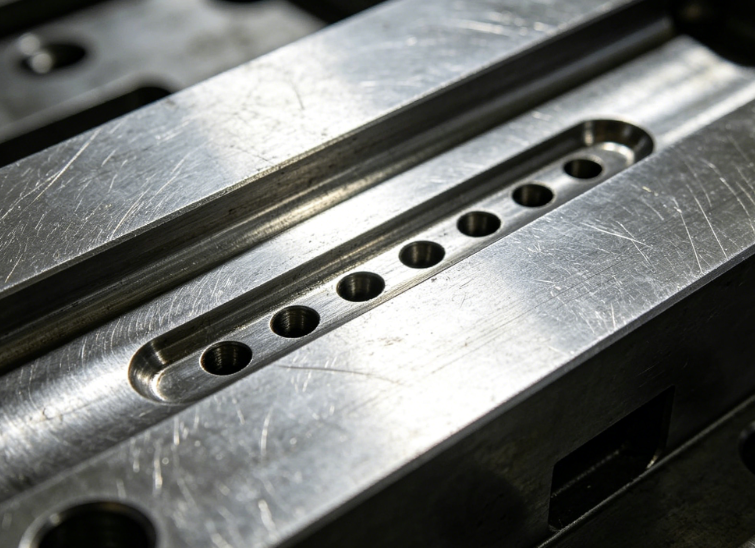
The most critical parameter is the depth of the venting groove near the cavity, which must be smaller than the flash margin of the plastic material. For common plastics, the recommended venting depth ranges are as follows: for soft materials such as PE, PP, and PA, the depth is 0.015–0.02 mm; for general engineering plastics such as ABS, PS, and AS, it is 0.02–0.025 mm; for PC, PMMA, and POM, it is 0.02–0.03 mm; for glass fiber reinforced materials such as PA66+GF, PBT+GF, and PPA, it can be increased to 0.03–0.04 mm due to higher viscosity. In actual mold design, 0.02 mm is the most commonly used universal depth, which is suitable for most plastic parts and avoids overflow.
The width of the venting groove is usually 5–12 mm. For narrow areas such as ribs and pillars, it can be reduced to 3–5 mm. The length of the shallow venting section is about 3–5 mm, after which the depth is increased to 0.2–0.5 mm to form a stepped structure. This stepped design ensures effective venting and prevents melt from flowing to the outer surface of the mold. The venting groove should be directly connected to the atmosphere or a collecting groove to avoid secondary gas accumulation.
III. Venting Position Layout
Venting grooves should be arranged at the last filling positions of the melt, where gas is most likely to be trapped. Typical positions include the end of the flow path, the corners of the parting surface, the bottom of deep ribs and deep pillars, the area around inserts and sliders, the weld line areas formed by multi-gate filling, and the areas with sudden wall thickness changes. Venting should not be designed near guide pillars, guide bushings, or positioning pins to prevent blockage and affect mold movement. For complex structures, it is necessary to conduct mold flow analysis to simulate the melt flow front and accurately determine venting positions.
IV. Venting Through Matching
ClearancesIn areas where direct venting grooves cannot be machined, such as deep cavities, slender pillars, and dense rib structures, venting can be achieved through matching clearances of ejector pins, sleeves, and inserts. The matching clearance of ejector pins is generally 0.01–0.02 mm, and the insert clearance is 0.005–0.015 mm. Such clearances can effectively discharge gas without causing flash. For high-precision molds, it is necessary to control the uniformity of clearances to avoid inconsistent venting and local defects.
V. Common Mistakes and Optimization Suggestions
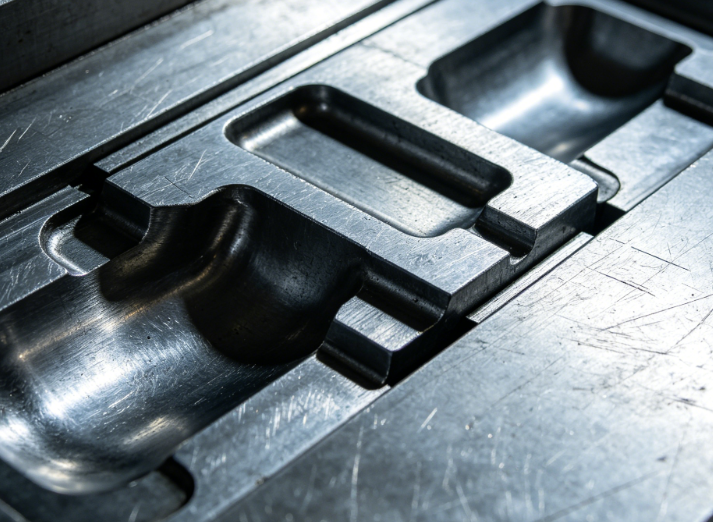
Many molds have poor venting due to excessively shallow or blocked venting grooves, or unreasonable positions. Some molds only set venting on one side of the parting surface, leading to unbalanced gas discharge. For high-speed injection and glass fiber reinforced materials, venting grooves should be appropriately widened and deepened within the allowable range. For high-gloss and mirror molds, venting grooves should be short and hidden to prevent affecting appearance. Regular cleaning of venting grooves is necessary during production, as carbon deposits and plastic residues will reduce venting efficiency.
VI. Summary
Venting groove design is a key part of injection mold design, which determines molding quality and production stability. The core is to select the appropriate depth based on plastic types, arrange positions at melt flow ends, and adopt stepped structures for efficient venting. Reasonable venting can eliminate trapped air defects, improve surface quality, reduce injection pressure, and extend mold service life. Standardized venting design helps achieve stable, efficient, and high-quality injection molding production.