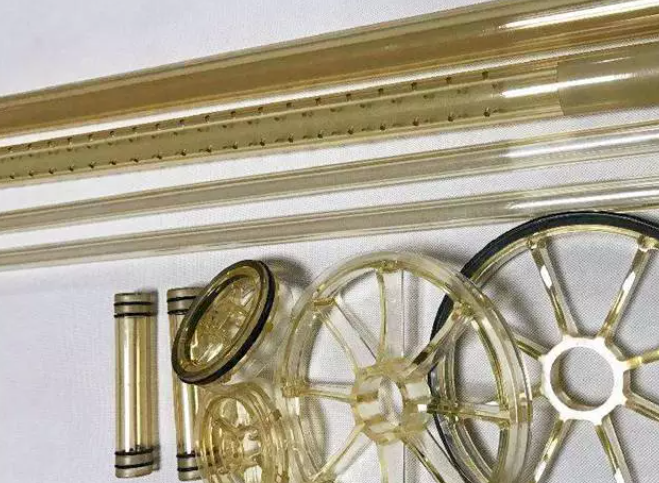
Exceptional heat resistance: PES has a high heat - distortion temperature, allowing long - term use at 180°C and short - term use above 200°C. It maintains integrity under high temperatures, making it ideal for electronics and other heat - demanding fields.
Good mechanical properties: It offers high tensile and flexural strength, rigidity, and some toughness, ensuring stable shapes and structures in various environments.
Superior electrical performance: With outstanding electrical insulation, PES keeps stable dielectric constant and dissipation factor across a wide range of temperatures and frequencies, preventing current leakage and signal interference.
Excellent water resistance: PES retains good performance in wet conditions or when in contact with water, resisting penetration and erosion. Its hydrolysis resistance suits applications such as medical devices.
High radiation tolerance: PES withstands gamma rays, electron beams, etc., remaining stable in radiation environments, applicable to aerospace and nuclear energy.
Hygienic safety: Non - toxic and odorless, PES meets food hygiene and medical device standards, suitable for food - contact utensils and medical products.