Hot Runner Injection Molding Process Debugging Guide
Hot runner systems offer significant advantages in material savings, part quality, and efficiency. Debugging requires precise control of temperature gradients, pressure-speed matching, and valve gate timing. The process follows the principle: Static First, Dynamic Second; Temperature Before Pressure.
1. Pre-Start Static Preparation: Foundation Checks
Thorough pre-start checks prevent faults during operation.
System Connection & Safety: Verify secure wiring between the temperature controller, heaters, and thermocouples. Ensure no gaps exist between the nozzles and mold gates to prevent leakage.
Temperature Gradient Setup: Establish a gradient where the Manifold Temperature > Nozzle Temperature (typically 5-10°C higher) to prevent premature freezing. For example, PP requires a manifold at 220-230°C and nozzles at 210-220°C; PC requires 300-310°C and 290-300°C respectively.
Sufficient Heat Soak: Allow 15-20 minutes for standard materials (PE/PP/ABS) and 20-30 minutes for high-temperature resins (PC/PA66). Confirm temperature stability within ±3°C.
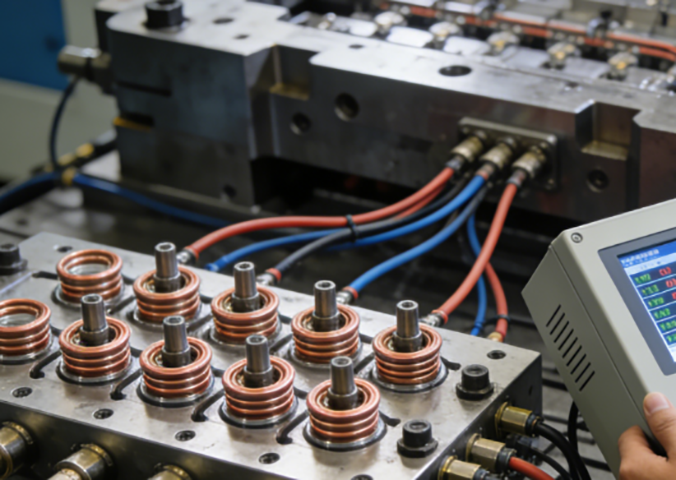
2. Core Parameter Tuning: Temperature-Pressure-Speed Synergy
After preheating, focus on stabilizing melt flow and cavity filling.
Temperature Calibration: Confirm actual nozzle temperatures match set values (±5°C tolerance). For multi-nozzle systems, ensure temperature uniformity (≤3°C variance) to prevent inconsistent filling. Reduce nozzle temperature by 5-10°C to eliminate stringing; increase manifold temperature first if flow is insufficient.
Injection Pressure & Speed: Hot runner pressure is typically 10-15% lower than cold runner. Start with low speed (30-40%) and medium pressure (80-100MPa). Increase speed incrementally for short shots; reduce packing pressure first for flash.
Packing Optimization: Set packing pressure to 40-60% of injection pressure. Adjust time based on wall thickness: 5-8 seconds for thin walls (<2mm) and 10-15 seconds for thick walls (>2mm). Balance is key to avoid sink marks (under-packing) or gate whitening (over-packing).
3. Valve Gate Timing: Precision Control
For valve-gated systems, timing directly impacts gate quality.
Opening Delay: A delay of 0.5-1 seconds after injection start prevents pre-flow and stringing. Advance by 0.2-0.5 seconds if short shots occur.
Closing Timing: Close 1-2 seconds before packing ends to ensure shrinkage compensation and prevent cold slugs. Closing too late causes stringing; too early causes sinks.
Actuation Speed: Maintain a moderate speed (50-60%) to prevent nozzle wear or needle seizure while ensuring cycle efficiency.

4. Troubleshooting & Optimization
Address common issues systematically.
Nozzle Leakage: Caused by excessive temperature or poor fit. Reduce temperature first; inspect for worn nozzles or misalignment if leakage persists.
Weld Lines: Caused by uneven temperatures or slow fill. Calibrate nozzle temperatures, increase injection speed, and raise mold temperature.
Gate Whitening/Cracking: Caused by high packing pressure or low temperature. Reduce packing by 10-15% and slightly increase nozzle temperature.
5. Finalization & Maintenance
Run 20-30 consecutive cycles to confirm stability, then record and lock parameters. Implement regular maintenance: clean nozzles and inspect heating elements/thermocouples to sustain long-term performance.