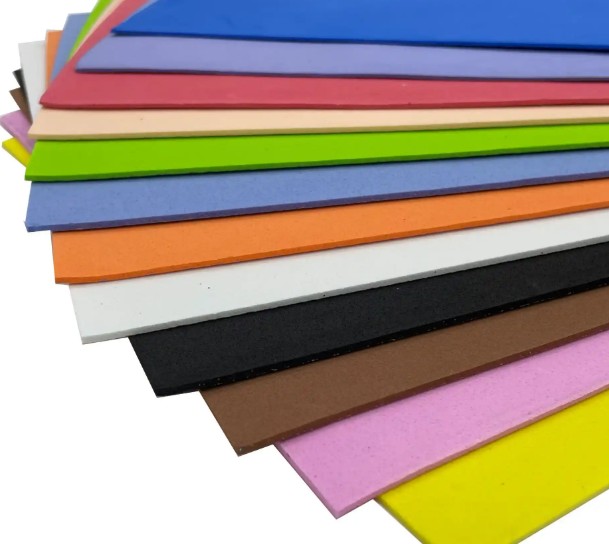
Offers high flexibility and elasticity, capable of withstanding tension and compression for effective cushioning.
Example: Used in sports shoe soles to reduce joint impact and enhance comfort.
Some EVA grades resist aging and ozone, maintaining performance in outdoor environments for extended periods.
Easily molded via injection, extrusion, blow molding, or foaming, adapting to diverse production needs.
Low density makes it easy to handle and transport, ideal for weight-sensitive applications (e.g., footwear).
Resistant to certain chemicals, though performance varies by formulation; suitable for mild chemical contact scenarios.
Closed-cell structure provides excellent water resistance, fitting for wet environments (e.g., swim gear, outdoor equipment).
Recyclable, aligning with sustainability goals to reduce resource waste and environmental impact.
Lower cost than many elastomers, enhancing product affordability for large-scale applications.
Smooth surface requires additional treatment for slip resistance in wet or high-traction scenarios.
Susceptible to UV and oxidative degradation, necessitating protective measures for long-term or outdoor use.
Softens, deforms, or melts at high temperatures, limiting applications in hot environments.
Easily eroded or contaminated by oils, requiring precautions in oily conditions.
Prone to wear under prolonged friction; often requires composite reinforcement for high-wear applications.
Poor dimensional stability post-molding demands strict process control for precision products.
May emit harmful substances during processing, requiring safety measures for personnel.